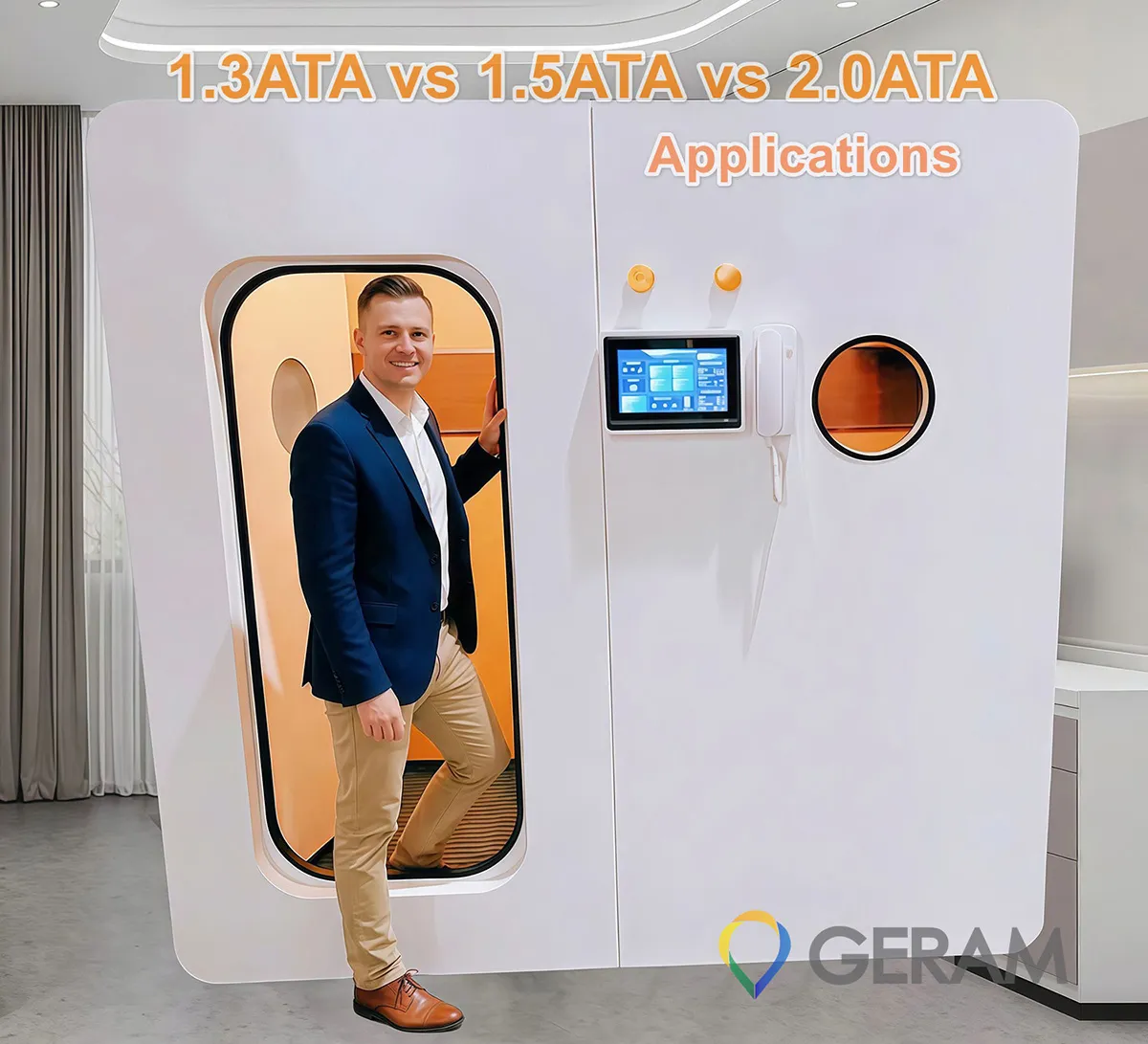
 Hyperbaric Oxygen Therapy Pressures Explained: 1.3ATA, 1.5ATA, and 2.0ATA ApplicationsIntroduction: Why Pressure Matters
Hyperbaric oxygen therapy (HBOT) delivers more than 95% oxygen under increased pressure. But not all pressures work the same way. The Undersea and Hyperbaric Medical Society (UHMS) states that therapeutic pressure must not be lower than 2.0 ATA, typically for 30–60 minutes per session. However, emerging research shows that lower pressures (1.3–1.5 ATA) affect completely different biological pathways—making them complementary rather than competing treatments.
1.3ATA – Mild Hyperbaric Oxygen Therapy (mHBOT)•Typical Applications: Chronic inflammation reduction, cognitive support, altitude sickness (FDA-approved for this use), wellness, fibromyalgia, mild traumatic brain injury.
•Key Research: A 2025 comparative study found 1.3ATA reduced 21 inflammatory cytokines (more than 2.0ATA, which reduced 20), influenced 27 unique epigenetic sites, and significantly improved memory.
•Key Mechanism: Targets distinct inflammatory pathways not activated at higher pressures.
1.5ATA – The Investigational Threshold•Typical Applications: Neurological recovery (traumatic brain injury, post-concussion syndrome, stroke), cerebral palsy, diabetic foot ulcers.
•Key Research: Harch et al. (2012) found 40 sessions at 1.5ATA significantly improved cognitive function in TBI patients. Faglia et al. (2015) found no significant difference in diabetic foot ulcer healing outcomes between 1.5ATA and 2.0ATA, with fewer side effects at the lower pressure. A 2013 study on cerebral palsy found 1.3ATA (ambient air), 1.5ATA (95% oxygen), and 1.75ATA (95% oxygen) all produced significant improvements with no outcome differences.
•Key Mechanism: Lower oxidative stress, better tolerated for neurological healing.
2.0ATA – Clinical & UHMS-Approved Indications•Typical Applications: UHMS-approved indications (decompression sickness, diabetic foot ulcers, delayed radiation injury, gas gangrene, carbon monoxide poisoning, osteomyelitis, compromised grafts, crush injuries, sudden hearing loss); adjunctive cancer support; select critically ill patients.
•Cancer Supportive Care: At ≥2.0ATA, HBOT alleviates tumor hypoxia, enhances sensitivity to chemotherapy/radiotherapy/immunotherapy, and mitigates radiation-induced tissue injury (e.g., head and neck radio necrosis, xerostomia). It also aids wound healing after breast cancer surgery. HBOT is adjunctive—used alongside oncology care, not as a standalone cancer treatment.
•Critically Ill Patients: HBOT at 2.0ATA combined with in-cabin ventilator therapy has been shown to improve respiratory and cardiopulmonary function in patients with liberation difficulty after tracheostomy. However, for COVID-19 induced ARDS, a 2024 phase II trial found no benefit at 2.4ATA.
•Key Research: The 2.0ATA group in the 2025 comparative study affected 134 epigenetic sites—~5× more than 1.3ATA, with zero overlap. Both groups became biologically younger, with high-pressure group showing greater changes. HBOT is AHA Class I for diabetic foot ulcers with osteomyelitis and Class II for chronic refractory osteomyelitis. A 2025 meta-analysis showed TBI patients improved in cognition, memory, and processing speed. HBOT achieved 87.5–100% efficacy for rheumatic/autoimmune skin ulcers.
•Key Mechanism: Tissue repair, angiogenesis, bactericidal effects, immune activation, alleviation of tumor hypoxia, radio sensitization, mitigation of radiation injury.
Pressure Comparison Summary•
1.3ATA: Primary applications include inflammation, cognition, altitude sickness, wellness. Key evidence: 21 cytokines reduced; 27 DMLs; memory improvement.
•
1.5ATA: Primary applications include TBI, post-concussion syndrome, stroke, DFU, cerebral palsy. Key evidence: Positive RCT (Harch 2012); equivalent to 2.0ATA for DFU with fewer side effects.
•
2.0ATA: Primary applications include UHMS-approved indications, cancer supportive/adjunctive care, and select critically ill patient management. Key evidence: 134 DMLs; AHA Class I–II; tissue repair & regeneration; alleviation of tumor hypoxia; enhanced chemo/radiotherapy sensitivity.
DMLs = Differentially Methylated Loci
Key TakeawayDifferent HBOT pressures do not compete—they complement. Lower pressures (1.3–1.5 ATA) are often preferred for chronic inflammation, neurological conditions, and wellness, while 2.0+ATA remains the standard for UHMS-approved indications, adjunctive cancer support, and select critically ill populations.
References•Undersea and Hyperbaric Medical Society (UHMS). Hyperbaric Oxygen Therapy Indications, 15th Edition. https://www.uhms.org
•Sonners, J. (2025). Comparative study of 1.3ATA vs. 2.0ATA HBOT on inflammation, cognition, and epigenetics. https://www.iowahbot.com/post/high-pressure-vs-low-pressure-hbot-what-the-latest-research-reveals
•Harch, P.G., et al. (2012). Hyperbaric oxygen therapy for mild traumatic brain injury persistent postconcussion syndrome: a randomized controlled trial. PLoS ONE, 7(6):e39979. https://doi.org/10.1371/journal.pone.0039979
•Faglia, E., et al. (2015). Hyperbaric oxygen therapy at 1.5ATA in diabetic foot ulcers. Journal of Diabetes Science and Technology. https://journals.sagepub.com/doi/10.1177/1932296815602168
•StatPearls. (2025). Hyperbaric Treatment of Chronic Refractory Osteomyelitis. https://www.ncbi.nlm.nih.gov/books/NBK430785/
•Deng, Q., et al. (2024). Hyperbaric oxygen: a multifaceted approach in cancer therapy. Medical Gas Research, 14(3):130-132. https://pubmed.ncbi.nlm.nih.gov/40232688/
•Breaking the hypoxia barrier: Advances and challenges of hyperbaric oxygen therapy in cancer treatment. ScienceDirect, 2025. https://www.sciencedirect.com/science/article/pii/S0753332225008972
•Kumar, V., et al. (2024). Radiation effects in head and neck and role of hyperbaric oxygen therapy: An adjunct to management. National Journal of Maxillofacial Surgery, 15(2):220-227. https://pubmed.ncbi.nlm.nih.gov/39234127/
•Hyperbaric oxygen therapy for complex wound management following breast cancer treatment: Single institution 10-year experience. PubMed, 2025. https://pubmed.ncbi.nlm.nih.gov/39506789/
•Effects of hyperbaric oxygen combined cabin ventilator on critically ill patients with liberation difficulty after tracheostomy. BioMedical Engineering OnLine, 2024, 23:30. https://pmc.ncbi.nlm.nih.gov/articles/PMC10921656/
•Five sessions of hyperbaric oxygen for critically ill patients with COVID-19-induced ARDS: A randomised, open label, phase II trial. Respiratory Medicine, 2024, 232:107744. https://www.sciencedirect.com/science/article/pii/S0954611124002191


